

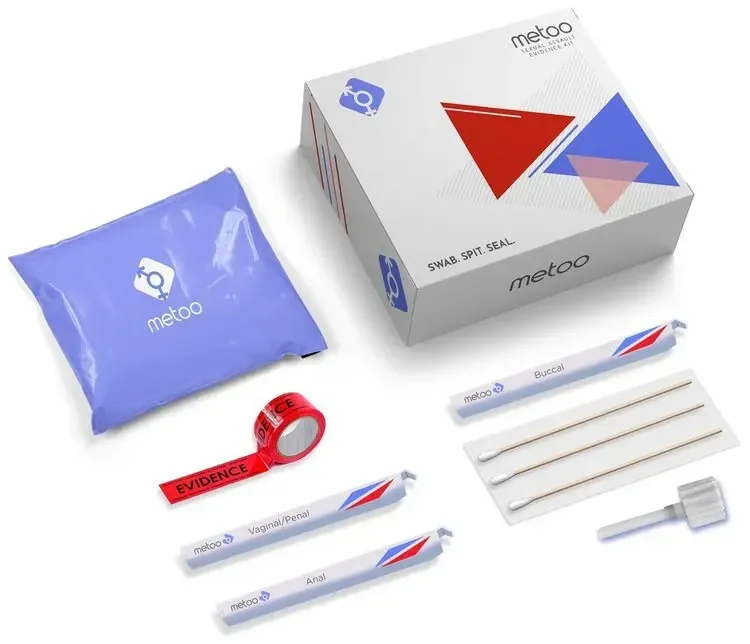
An estimated 49,248 rape kits sit untested in evidence storage across the United States right now, according to the most recent count from the Joyful Heart Foundation. More than a decade into a well-funded, well-publicized national campaign to "end the backlog," some states have genuinely eliminated theirs. Others are moving backward: New Mexico's untested kit count jumped from 249 to 1,419 in a single year. The story of why is really a story about three overlapping federal laws, none of which alone was ever built to finish the job.
What a SAFE Exam Actually Guarantees You
A Sexual Assault Forensic Exam( SAFE exam or rape kit) is a medical exam performed by a trained examiner that documents injury and collects evidence, which is then transferred, with the victim's consent, to a law enforcement agency and logged into evidence. The exam itself and the underlying medical care are governed mostly by state law, which varies considerably. But one federal law, the Sexual Assault Survivors' Rights Act of 2016, does set a specific floor of guarantees, with an important caveat: it applies directly only to cases prosecuted in federal court, such as an assault on federal land.
Under that Act, survivors have the right to a forensic medical exam at no cost, the right to have the resulting kit preserved for the length of the statute of limitations or twenty years, whichever is shorter, the right to written notice before a kit is ever destroyed, and the right to be informed of the exam's results. Most states have since passed their own, similar victim's-rights statutes modeled on this federal framework, but coverage, notice periods, and enforcement mechanisms differ meaningfully state to state, which is part of why a kit's fate still depends heavily on where the assault happened.
Two Different Backlogs, Hiding in One Number
"Backlog" isn't one thing. Some kits are collected and then never submitted to a crime lab at all, often because a victim didn't want to pursue prosecution, or because a department made a discretionary call not to test. Others are submitted and simply sit untested for months or years because labs are underfunded, understaffed, or prioritizing other cases. The distinction matters because the policy fix for each is different: the first is a training-and-protocol problem about when kits get submitted; the second is a capacity problem about testing throughput. National advocacy campaigns tend to collapse both into a single headline number, which makes for a strong statistic but a blurrier policy picture.
Three Federal Laws, Not One
There isn't a single “rape kit law”, there are three federal funding streams, passed over eighteen years.
The oldest is the Debbie Smith Act, first passed in 2004 and named for a survivor whose own case took six and a half years to resolve because her kit went untested. It authorizes up to $151 million a year for the DNA Backlog Elimination Program, funding crime labs to actually test kits and train examiners. Since 2004, it has supported testing on more than 1.6 million DNA cases and produced over 328,000 database hits, nearly half of all DNA matches made nationally. It was reauthorized again in 2023, extending funding through FY2029.
The second is the Sexual Assault Kit Initiative (SAKI), a Department of Justice discretionary grant program launched in 2015 specifically to help jurisdictions inventory and clear existing backlogs, as opposed to the ongoing flow the Debbie Smith Act funds. SAKI is currently funded at $51.5 million.
The third is VAWA itself. The 2022 reauthorization created new grant authority specifically aimed at improving the availability of SAFE exams and addressing the backlog, layered on top of, not replacing, the other two acts. Three separate federal laws, three separate funding streams, three separate bureaucracies, all aimed at overlapping pieces of the same problem. That fragmentation is itself part of the explanation for why, twenty years after the first federal dollar was appropriated to this problem, a five-figure number of kits are still sitting untested.
The Barrier Before the Backlog: Not Enough Nurses
Testing funding assumes a kit gets collected competently in the first place, and that assumption is under real strain. As of 2025, fewer than 2,150 certified Sexual Assault Nurse Examiners (SANEs) serve the entire country, and only about a quarter of U.S. hospitals have any kind of forensic nursing program at all. The gaps are worst in rural and tribal communities.
Adding to the disruption, the field's main credentialing body, the International Association of Forensic Nurses, dissolved in 2026, with training resources moving to the Emergency Nurses Association and certification shifting to the American Nurses Credentialing Center. In other words: before a kit can even become part of the "backlog," a survivor first has to find a nurse trained to collect it, and in large stretches of the country, that's not guaranteed.
A Patchwork of State Responses
Every state, plus D.C. and Puerto Rico, has now enacted some form of legislation governing how sexual assault evidence must be handled, such as tracking systems, testing deadlines, victim notification requirements. But the details, and the results, vary widely. Washington State's Sexual Assault Forensic Examination Best Practices Advisory Group reported real success in clearing its backlog while flagging further policy gaps. New Mexico's Department of Public Safety, by contrast, reported its untested kit count nearly sextupling in a single year. Progress has been real but incomplete.
Where This Leaves Survivors in 2026
The backlog was never going to be solved by a single law, because it was never caused by a single gap. It's the product of a workforce shortage at the point of collection, three overlapping and unevenly funded federal grant programs at the point of testing, and fifty different state frameworks at the point of enforcement. VAWA's 2022 contribution, new SAFE exam and backlog grants, is a real addition to that landscape, but it's one layer on a stack that was already uneven before it arrived. Flat funding for SAKI, an unfunded SANE directory mandate, and a credentialing system mid-transition suggest the gap between what the law promises survivors and what they can actually access is not closing on its own.