


I'm a black woman, and my hair has always been a topic of discussion at the office. Colleagues like to ask to touch my hair, or let me know what their preferences of my hairstyles are. They'll ask questions like “ is it yours?” or “how often do you wash it?”. Then there's the aspect of professionalism. With black hair specifically, there are strong opinions on what is considered professional, with a leaning to more Eurocentric beauty standards usually being considered the baseline for a professional aesthetic. So what does the law look like when you have to address questions around your hair at work?
The Crown Act
The Crown stands for Creates, a Respectful and Open World for Natural Hair. It explicitly extends race discrimination protections provided by Title VII and the Civil Rights Act of 1964 to include hair texture and protective styles like locs, braids, twists, Bantu knots and Afros in employment, education, housing, and public accommodations. Hair is deeply tied to Black culture and identity. Protective hairstyles are inseparable from race and must receive race-equivalent protection.
Why it matters
Professional appearance standards are not neutral. They encode the aesthetic norms of the dominant group and enforce them through employment consequences. Requiring assimilation to Eurocentric hair standards is a mechanism of racial dominance operating through the workplace. The law's failure to name this is not neutrality, it is complicity. The Eurocentric professional aesthetic is a historically-produced ideal of the human. It pathologizes the Black phenotype. Requiring Black employees to conform to this aesthetic demands a form of self-erasure that goes beyond grooming policy into the erasure of cultural selfhood.
What coverage looks like
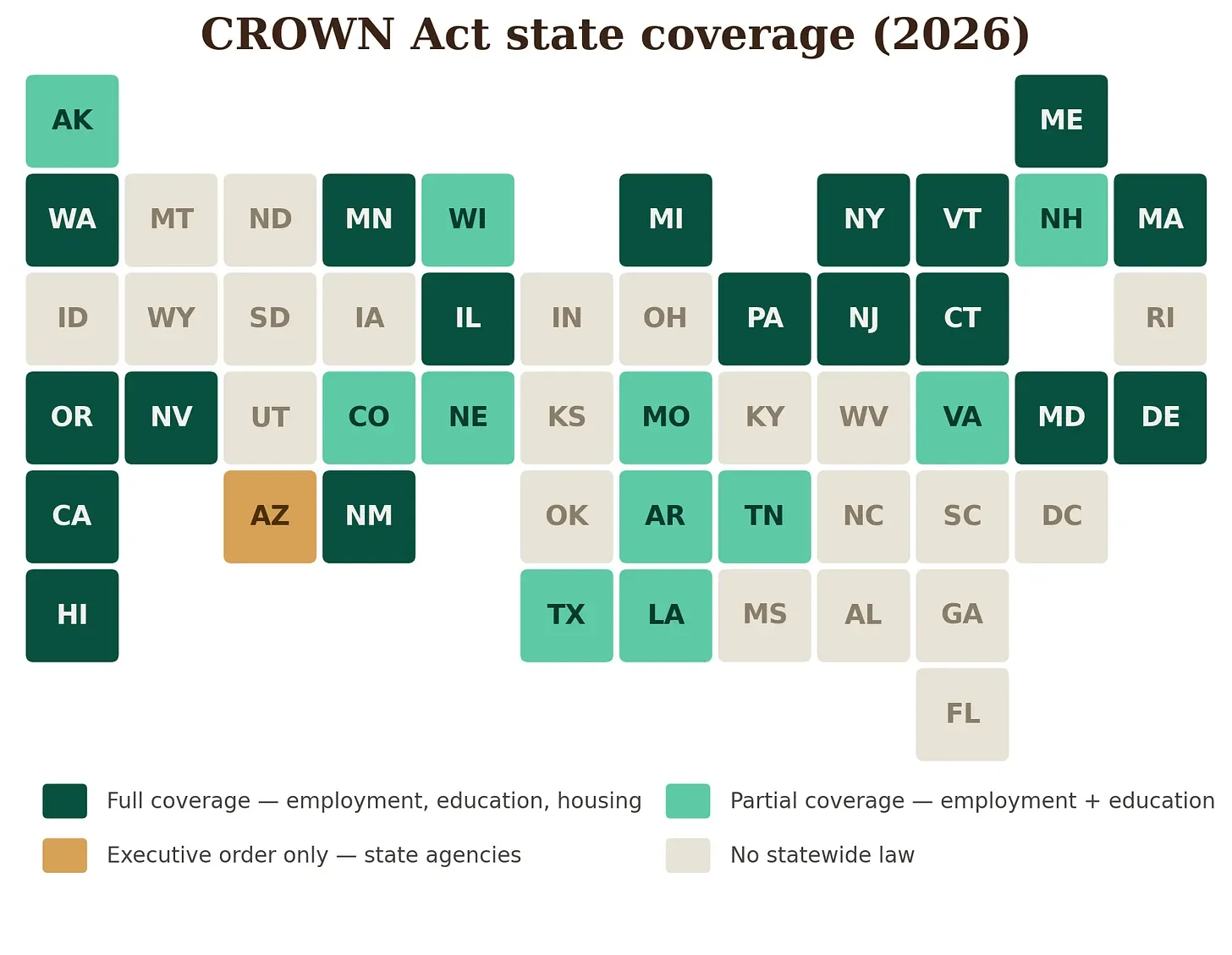
No federal law exists to enforce the Crown Act. It varies by state. The table above shows the variation in coverage across states, in employment, education and housing. The South, where Black workers and students are most concentrated, remains the largest gap in the map. Without federal legislation, a Black person's right to wear locs to work depends entirely on which side of a state line they're standing on. Enforcement of the Crown Act follows the same procedure as any other discrimination case.
What you can do about it
Enforcement requires you to be willing to file a complaint, and a jurisdiction with the political will to have passed the law in the first place. The law doesn't legislate curiosity, prohibit touching of your hair or making your hair the subject of social commentary. What it does do is name the fact that hair discrimination is racial discrimination. Naming the mechanism is the first step in dismantling it.